
Casio F-91W-1
The Definitive Affordable Digital Watch
The Casio F-91W-1 is arguably the definitive affordable digital watch.
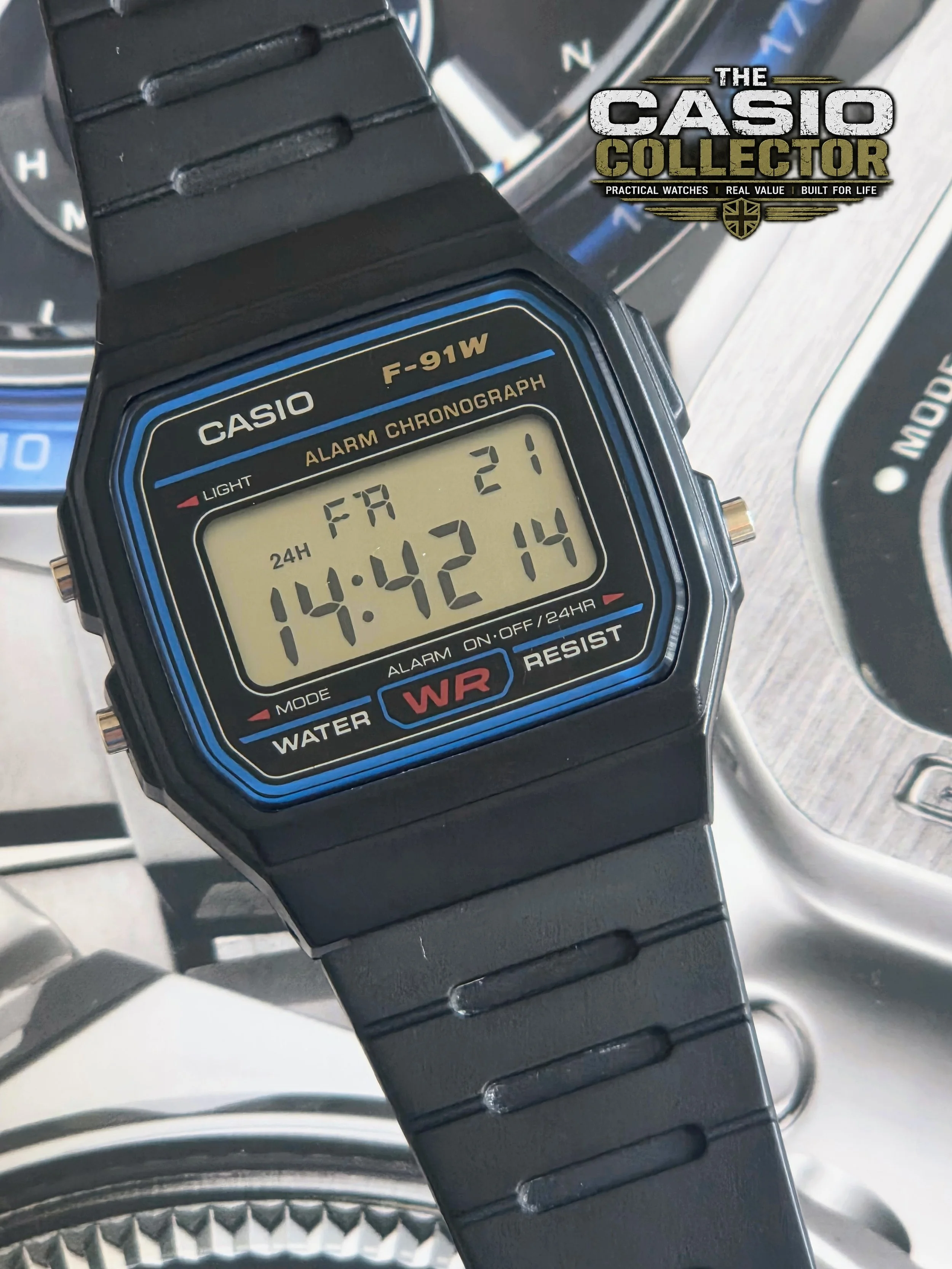
Introduced in 1989, it has remained in production with its fundamental design almost completely unchanged. Its compact black resin case, blue-and-red face graphics and straightforward LCD display have become recognisable throughout the world.
There are Casios with more functions, stronger construction and better illumination, but very few watches have achieved the same combination of affordability, practicality and universal recognition.
For me, the F-91W is more than simply a cheap digital watch.
It represents Casio’s ability to remove everything unnecessary while retaining exactly what most people need.
A Design That Barely Needed to Change
The design of the F-91W has remained largely unchanged since its 1989 introduction.
That longevity is remarkable.
Technology has moved through countless generations during that time, yet the basic requirements of an everyday wristwatch haven’t changed. People still need to know the time, day and date, and occasionally find a stopwatch or alarm useful.
The F-91W provides all of that within an exceptionally compact and inexpensive package.
Its blue border, red WR marking and yellow function labels create a face that’s colourful without appearing overly busy. Every printed marking has a purpose, helping explain the operation of the three side buttons.
It’s an example of functional design becoming iconic through familiarity and long-term usefulness rather than deliberate luxury or exclusivity.
Instantly Recognisable
The F-91W is one of those watches that people recognise even if they don’t know its model number.
Its appearance has become almost a visual shorthand for “digital watch”.
The rectangular LCD, slim black case and blue outline are so familiar that changing any one of them would fundamentally alter the personality of the watch.
It isn’t traditionally beautiful in the same way as an expensive mechanical watch, but it has a clear and honest design.
Nothing is attempting to look more costly than it really is.
The resin case looks like resin, the strap is simple and the display prioritises information over decoration.
That honesty is one of the things I like most about it.
Only 21 Grams
The F-91W measures approximately 38.2 × 35.2 × 8.5mm and weighs just 21 grams.
Those figures make it one of the easiest watches imaginable to wear.
It sits almost completely flat against the wrist and slips beneath practically any shirt, jumper or jacket cuff. Once it’s on, there’s very little weight to remind you that you’re wearing it.
That’s a considerable contrast to the large cases and protective structures found on modern G-Shocks.
The F-91W doesn’t try to create wrist presence through size. Its presence comes from its instantly recognisable design.
Its compact proportions also make it genuinely unisex and suitable for an enormous range of wrist sizes.
At a time when many watches have become increasingly large, the F-91W remains proof that a small watch can still be clear, useful and full of character.
The Simple Resin Strap
The black resin strap is light, flexible and well matched to the case.
There’s nothing elaborate about it.
It uses a conventional buckle and provides enough adjustment positions to accommodate a wide range of wrists. Combined with the extremely low case weight, it makes the F-91W comfortable enough to wear throughout the day or even overnight.
The strap is often the first component to show its age.
After years of use, resin can become stiff, cracked or eventually break. Fortunately, replacement straps are widely available and inexpensive.
The strap isn’t designed to last forever, but the watch itself can easily continue operating through several replacements.
For a model intended to remain affordable, that feels entirely reasonable.
Everything You Need at a Glance
The LCD displays the hour, minute, seconds, day and date simultaneously.
There’s no need to press a button simply to check the calendar.
The time occupies the largest section of the display, while the day and date sit clearly above it. Small indicators confirm whether the alarm or hourly time signal has been activated.
It’s an extremely efficient use of a relatively small screen.
The display doesn’t include decorative graphics, animations or multiple data fields competing for attention.
Everything shown is useful.
This ability to present the essential information clearly is one of the main reasons the F-91W still works so well decades after its introduction.
Three Buttons and No Complication
The F-91W is controlled by three small pushers.
The upper-left button activates the light and assists with settings, the lower-left button cycles through the watch’s modes, and the right-hand button controls the stopwatch and changes selected values.
It’s a system that quickly becomes intuitive.
There are only a few modes to navigate, and every function can be reached with a small number of button presses.
No instruction manual is likely to be needed after the first few minutes.
That simplicity is becoming increasingly rare.
Modern connected watches can provide an enormous amount of information, but they also require charging, software updates, applications and menus.
The F-91W asks almost nothing from its owner.
A Basic but Useful Stopwatch
A 1/100-second stopwatch is included, with a maximum capacity of 59 minutes and 59.99 seconds.
It supports elapsed-time measurement, split times and first-and-second-place finishing times.
The stopwatch is limited compared with more advanced Casios capable of timing for 24 hours or longer.
For everyday use, however, it’s perfectly adequate.
It can time a short run, cooking, exercise intervals, parking or countless other activities lasting less than an hour.
It’s also extremely quick to access and operate, which is often more important than having a long list of additional timing modes.
Daily Alarm and Hourly Signal
The F-91W includes a daily alarm and optional hourly time signal.
The alarm is deliberately simple. It can be set to sound once every day at the selected time, making it useful for basic reminders or waking up.
The hourly signal produces a short beep at the beginning of each hour.
It’s a small feature, but one that has become closely associated with traditional digital watches.
Some owners will immediately disable it, while others consider the hourly beep an essential part of the experience.
Small display indicators show whether either function is active.
The Famous Weak Light
If the F-91W has one obvious weakness, it’s the illumination.
A small LED positioned at the side of the display provides just enough light to read the time in darkness.
It works, but only just.
The lighting is concentrated towards one side of the LCD and doesn’t illuminate the entire display evenly. Compared with electro-luminescent watches such as the F-105W or A168, it appears distinctly basic.
This has become such a familiar characteristic of the F-91W that it almost feels like part of its personality.
It would undoubtedly be more practical with a brighter and more even backlight, but improving it might require changes to the case, module, power consumption or price.
The light performs its basic purpose, even if it does so without much enthusiasm.
Seven Years from One Battery
The F-91W uses a CR2016 battery, with Casio quoting an approximate battery life of seven years.
That longevity is one of the watch’s greatest practical strengths.
There’s no charging schedule to remember and no rechargeable battery gradually losing capacity. Once the battery is installed, the watch can potentially operate for the best part of a decade.
Many examples reportedly run beyond the quoted figure when the alarm and light are used sparingly, although Casio’s official estimate remains seven years.
Accuracy is rated to approximately ±30 seconds per month.
It doesn’t automatically synchronise with a radio signal, satellite or smartphone, but occasional manual correction is hardly a major inconvenience.
Basic Water Resistance
Casio describes the F-91W simply as water resistant.
It’s designed to cope with everyday splashes, hand washing and sudden rain, but it doesn’t carry the 50-metre rating of the W-59 or the stronger protection of a G-Shock.
I wouldn’t choose it specifically for swimming or prolonged exposure to water.
That limitation is worth understanding, but it doesn’t prevent the F-91W from being an effective everyday watch.
It was designed around minimum size, weight and cost rather than maximum ruggedness.
For anyone requiring greater water resistance, Casio offers plenty of alternatives. The remarkable thing is how much everyday usefulness the F-91W provides despite its tiny dimensions and modest price.
F-91W, W-59 or F-84W?
These three watches represent different interpretations of Casio’s classic lightweight digital formula.
The F-84W has the most old-fashioned appearance, with conventional-looking lugs and a face design that feels distinctly earlier. Its Japanese-market character makes it particularly interesting to collectors.
The W-59 has a slightly tougher-looking case and the practical advantage of 50-metre water resistance.
The F-91W sits between them as the most universally recognisable and widely available choice.
Functionally, all three watches follow a similar philosophy. They provide the time, day, date, stopwatch, alarm, hourly signal and basic illumination without unnecessary complication.
The decision therefore comes down to priorities.
The F-84W offers the strongest old-school character, the W-59 provides better water resistance, and the F-91W delivers the purest expression of Casio’s globally recognised digital design.
As a collector, I can appreciate all three for different reasons.
Why Did the F-91W Become So Successful?
There’s no single unusual feature responsible for the F-91W’s success.
It became popular because the complete package works.
It’s inexpensive enough to be accessible, reliable enough to be trusted and simple enough for almost anyone to operate.
Its compact size makes it comfortable on nearly any wrist, while the clear display provides genuinely useful information.
Casio also designed the watch for efficient manufacture.
The resin case and strap, reduced component count and straightforward pin connections all help maintain affordability without removing the functions people actually use.
The F-91W isn’t successful because it excels in one spectacular area.
It succeeds because there’s very little wrong with it for the price.
From Ordinary Object to Design Icon
One of the most interesting things about the F-91W is how its cultural position has changed.
It began as an inexpensive contemporary digital watch. Over time, it became an ordinary everyday object used throughout the world.
Eventually, that familiarity transformed it into an icon.
People now buy the F-91W for nostalgia, fashion and collecting as well as pure practicality.
Despite that status, the watch remains affordable and readily available. It hasn’t been artificially repositioned as an expensive heritage product.
That may be its greatest achievement.
The F-91W has become legendary without losing the accessibility that made it successful in the first place.
At one point, I owned 25 of the 26 F-91W variants. The only one missing was the exceptionally rare Tiffany-blue version, which can command more than £300 when one appears. Eventually, I decided to sell the collection and retain the original black F-91W-1 and the Pac-Man. After owning almost the entire range, the original is still the version I consider definitive.
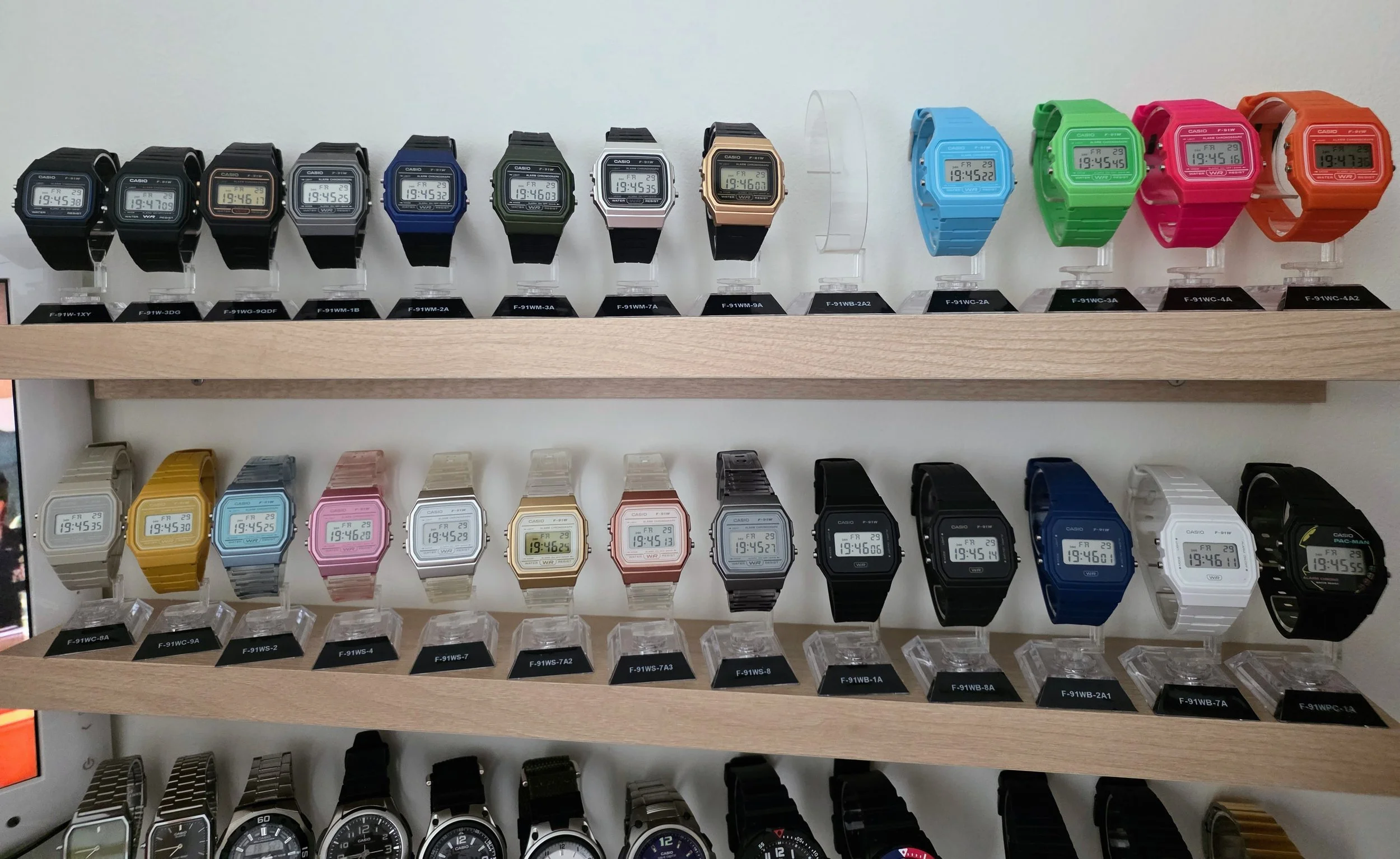
Here’s the 25 of the 26 currently available F-91W the I had in my collection.
The Casio Collector Verdict
The Casio F-91W-1 is one of the most important watches Casio has ever produced.
It isn’t the toughest, most accurate or most technologically advanced model in the catalogue.
Its water resistance is basic, its LED light is famously weak and its stopwatch is limited to just under an hour.
Yet none of those shortcomings have prevented it from remaining useful and popular since 1989.
The F-91W gets the fundamentals right.
It’s lightweight, comfortable, legible, reliable and exceptionally easy to use. Its stopwatch, alarm, calendar and seven-year battery provide enough functionality for everyday life without introducing unnecessary complication.
For me, the original black F-91W-1 is still the definitive version.
The blue border, red WR marking and yellow button labels give it an identity that countless colour variations and related models can build upon, but never completely replace.
Every Casio collection should contain one—not because it’s rare or expensive, but because it represents the company at its most focused.
Simple, affordable and recognised around the world—the F-91W-1 earned its legendary reputation one ordinary day at a time.
Specifications
Model: Casio F-91W-1
Introduced: 1989
Display: Digital LCD
Case and Bezel: Resin
Strap: Resin
Glass: Resin glass
Dimensions: 38.2 × 35.2 × 8.5mm
Weight: 21g
Water Resistance: Water resistant
Battery: CR2016
Approximate Battery Life: Seven years
Stopwatch: 1/100 second
Stopwatch Capacity: 59 minutes, 59.99 seconds
Stopwatch Modes: Elapsed time, split time and first/second-place times
Alarm: Daily alarm
Hourly Time Signal: Yes
Lighting: LED light
Calendar: Automatic calendar set to 28 days for February
Time Format: 12/24-hour
Accuracy: ±30 seconds per month
Compatible Wrist Size: 145–200mm
A Video Review will be added once created and edited