
Casio STR-300C-1
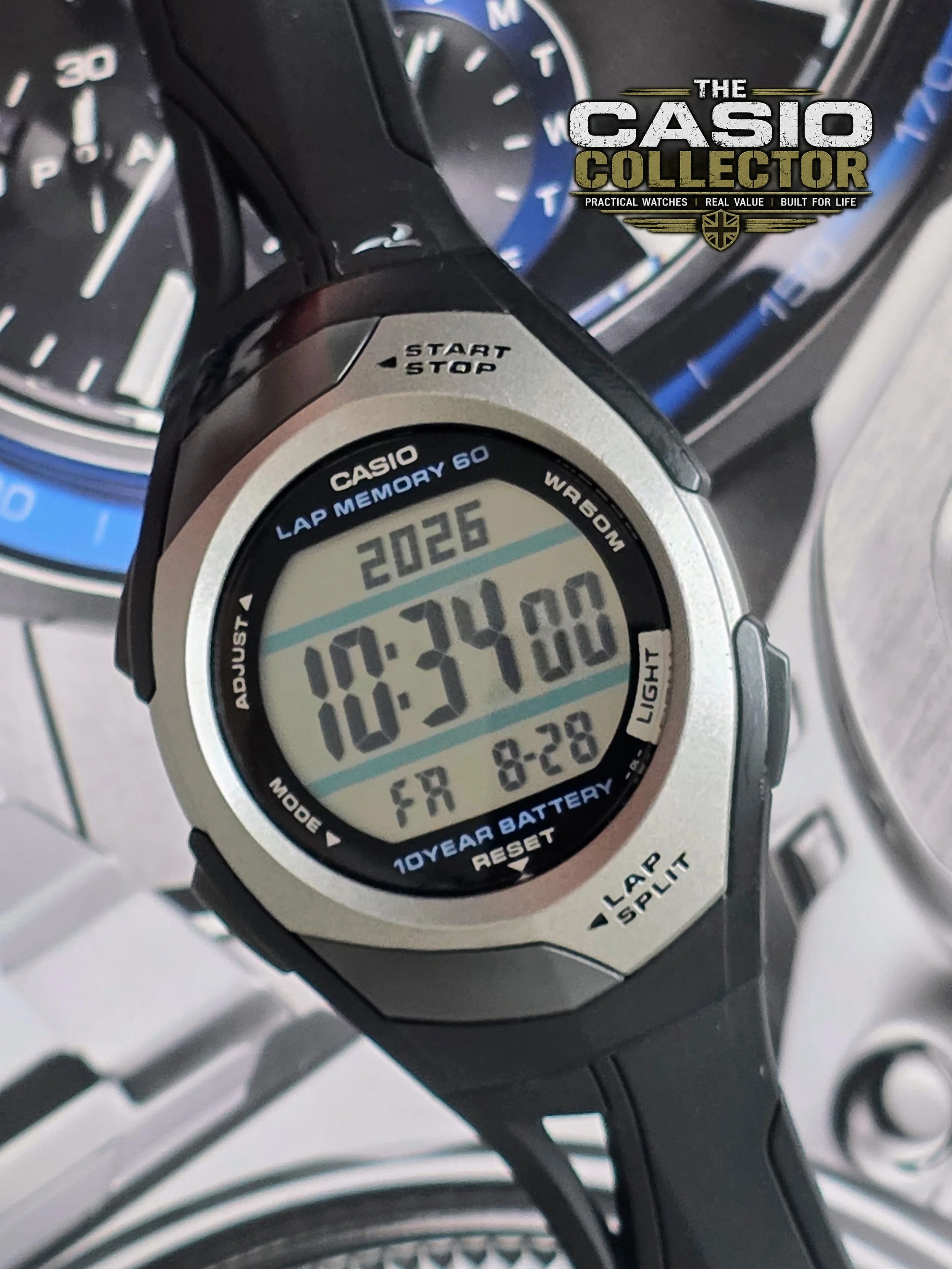
The Non-Runner That Wasn't Ready to Die
Some watches enter my collection because I've specifically been looking for them. Others arrive becausethey're cheap, interesting and look like they might present a challenge.
My Casio STR-300C-1 definitely falls into the second category.
I spotted this one on Vinted being sold as a non-runner for spares or repair and paid just a few pounds for it. According to the previous owner, they'd bought the watch more than ten years earlier but had barely worn it. Eventually the battery died, the watch went into a drawer and there it stayed.
During a later clear-out they decided to have the battery replaced, only to be told that the watch itself was faulty.
At that point it was sold as a non-runner.
Which, naturally, made it considerably more interesting to me.
A New Battery Didn't Fix It
When the STR-300C arrived, the first thing I tried was the obvious solution: fit a fresh battery and confirm what what mentioned by the seller.
Nothing.
So the diagnosis that the watch was faulty appeared to be correct.
But a dead digital Casio isn't necessarily a dead digital Casio.
Rather than consigning it to the parts box, I decided to go a little further and strip down the module 2575 to see whether I could find anything obvious.
I removed the module, carefully dismantled it and cleaned the circuit board with isopropyl alcohol before putting everything back together.
Fresh battery back in...
And it worked.
Even better, it has continued to work perfectly for the several months I've owned it since.
Sometimes the most satisfying restorations aren't the ones requiring a pile of replacement parts. They'rethe watches somebody else has already written off that simply need a little patience and attention.
Designed for Runners
Like my earlier STR-200-2, the STR-300C isn't simply a digital watch with a stopwatch added as an afterthought.
The STR series was designed with runners in mind.
You can enter your stride length and the watch uses that information alongside the stopwatch to calculate distance travelled. The pacer signal can be configured between 100 and 200 beats per minute, helping a runner maintain a consistent rhythm.
The stopwatch measures elapsed, lap and split times and can store up to 61 records, with a Recall Mode allowing previous results to be viewed afterwards. It also keeps track of total distance and records the best lap time.
There is something I really like about this approach.
No GPS. No smartphone. No app. No account to create.
You give the watch some basic information and it gets on with the job.
A Seriously Capable Stopwatch
The stopwatch is undoubtedly the main attraction.
Timing is measured down to 1/100th of a second during the earlier stages of a session, with a maximum elapsed-time capacity of just under 100 hours.
Distance can be displayed in kilometres or miles depending on whether stride length has been entered in centimetres or inches.
Lap and split numbers run from 01 to 99, while the memory system stores individual training logs.
It's considerably more sophisticated than the stopwatch fitted to a typical Casio digital watch and showsthat the STR-300C was designed as a genuine training tool rather than simply being styled to look sporty.
Ten Years From One Battery
Unlike my solar-powered STR-200-2, the STR-300C uses a conventional CR2025 battery.
Casio rates battery life at approximately 10 years under its specified usage conditions, which is impressive in its own right.
In fact, that specification makes the history of my particular watch quite believable.
The previous owner had owned it for more than a decade, barely used it and eventually found it with a dead battery after spending years in a drawer.
A decade from an ordinary CR2025 is hardly something to complain about.
That said, this is one area where I personally prefer the older STR-200. My 2002 example is solar powered and is remarkably still operating on its original rechargeable cell.
The STR-300C's ten-year battery life is excellent.
But more than two decades from the original rechargeable cell in my STR-200 is difficult to beat.
Lightweight and Comfortable
One thing the STR-300C does particularly well is weight.
At only 30 grams, it's extremely light on the wrist.
That makes perfect sense for something intended for running. You don't want a heavy watch bouncing around on your wrist for several miles, and once the STR-300C is on, it's very easy to forget you're wearing it.
The resin case and strap also make it a practical watch for exercise and general everyday use.
There's 50 metres of water resistance, which is useful for a sports-oriented watch, although as with any older example I wouldn't personally rely on the original water-resistance rating without having the watch appropriately tested first.
Plenty of Features Away From Running
The running functions might be the STR-300C's speciality, but there's plenty here for normal everyday use too.
You get a 100-hour countdown timer with auto-repeat, five independent daily alarms, an hourly timesignal and dual time.
One of the five alarms can operate as a snooze alarm, while the remaining four are one-time alarms.
There's also an LED backlight with afterglow and an automatic light switch, so raising the watch towards you can illuminate the display when the feature is enabled.
The automatic calendar runs through to 2039, and both 12- and 24-hour time formats are available.
It's an impressive amount of functionality packed into a watch weighing just 30 grams.
STR-200 or STR-300?
Owning both inevitably leads to a comparison.
And personally,
I prefer my STR-200-2.
That isn't because the STR-300C is a bad watch. Far from it.
The STR-300C is lighter, extremely practical and retains the excellent running functionality that makes this series interesting in the first place.
But the older STR-200 has more character for me.
I prefer its early-2000s styling, its more unusual appearance and particularly its solar-powered module. TheSTR-300C feels like the cleaner and more conventional evolution of the idea, whereas the STR-200 feels unmistakably like a product of its era.
Objectively, there isn't much wrong with the STR-300C.
Subjectively, I'd reach for the STR-200 first.
And that's precisely why I enjoy owning both.
The Casio Collector Verdict
My Casio STR-300C-1 is a perfect example of why I enjoy buying inexpensive non-running watches.
Someone had been told it was faulty. A replacement battery hadn't solved the problem, so it was eventually sold for a few pounds as a source of spares.
A module strip-down, a careful clean of the circuit board with isopropyl alcohol and a reassembly later, itwas alive again.
Several months on, it's still working perfectly.
The watch itself is also far more capable than its relatively simple appearance might suggest. The lap and split memory, distance calculations, pacer, countdown timer, five alarms and dual-time function make this a genuinely useful sports watch even today.
Do I prefer it to my STR-200-2?
No.
The older watch wins for me on character, design and its solar power system.
But considering this STR-300C cost me little more than spares money and was supposedly beyond repair, bringing it back to life has given me a connection to this particular watch that I probably wouldn't have had if I'd simply bought a working example.
Another Casio saved from the parts bin.
That's reason enough for it to have a place in my collection.
Specifications
Model: Casio STR-300C-1
Module: 2575
Display: Digital LCD
Case/bezel: Resin
Strap: Resin
Glass: Resin
Dimensions: 48.2 × 35.2 × 12.1 mm
Weight: 30 g
Water resistance: 50 metres
Battery: CR2025
Approximate battery life: 10 years
Accuracy: ±15 seconds per month
Time format: 12/24 hour
Calendar: Automatic calendar to 2039
Stopwatch: 1/100-second timing with elapsed, lap and split measurement
Maximum stopwatch measurement: 99 hours, 59 minutes, 59 seconds
Memory: Up to 61 records
Distance functions: Stride-length input, distance calculation and cumulative distance
Running functions: Pacer signal, lap/split numbers and best-lap display
Distance units: Kilometres or miles
Countdown timer: Up to 100 hours with auto-repeat
Alarms: 5 independent daily alarms, including snooze capability
Hourly time signal: Yes
Dual time: Yes
Backlight: Green LED with afterglow and auto-light switch
A Video Review will be added once created and edited